Ghastly Good Taste by John Betjeman
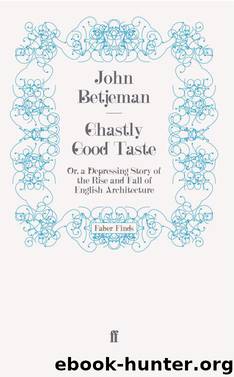
Author:John Betjeman [John Betjeman]
Language: eng
Format: epub
ISBN: 9780571286911
Publisher: Faber & Faber
Published: 2011-04-26T04:00:00+00:00
Sir John Vanbrugh, who built it, would have been, had he lived today, an interior decorator to the very rich. In the eighteenth century there was no such thing. Men were either architects or artists. Sir John Vanbrugh was a genius, but wholly neither. His other enormous building, Castle Howard, is no wit as imposing as Hawksmoor’s comparatively small mausoleum which stands in its grounds. Hawksmoor wrapped his life in an industrious obscurity. Though it would be hard to believe that Vanbrugh, who also wrote plays, was idle.
It should not be hard to tell a building which has been built purely for effect from one that has been built largely from convenience. The one fails to satisfy after close scrutiny. The second grows on one, although it may not strike the eye at first. Few people bother to look at Chelsea Hospital, London, which I regard as Wren’s masterpiece. There it stands, a stately unadorned brick building, whose north walls are only relieved by high round-headed windows, the whole façade split in two by a noble attached portico, behind whose pediment rises one of those stone cupolas that only Wren perfected, and the ‘thirty-nine’ buses shift a few indifferent Londoners past it every day. Yet even Carlyle, who was little alive to an appreciation of the visual arts, heaven knows, is said to have remarked: ‘I had passed it daily for many years without thinking about it, and one day I began to reflect that it had always been a pleasure to me to see it, and I looked at it more attentively and saw that it was quiet and dignified and the work of a gentleman.’ Here is a building that combines convenience of plan with elegance of dimensions. The Gothic tradition was not dead. It did not even sleep. It was translated into humanism. No one could say that all Wren’s city churches were Renaissance buildings. Who saw an ancient Roman edifice which had even a detail like any part of the soaring steeple of St Bride’s Church in Fleet Street?
And not only did the Gothic tradition go on in the larger public buildings of the late seventeenth and throughout the eighteenth century, but also in domestic architecture. An upper class ruled the country and acquired a dignity suitable to its office. The eighteenth century has been interpreted by the fanciful performances of the Lyric Theatre, Hammersmith, as an age of Ombre and ‘Obleegement’ and a quaint old-world artiness that has already descended to the higher-class teashops. Edmund Dulac, Lovat Fraser and their countless imitators have sentimentalised a hard, reasonable age, which produced a hard and reasonable architecture—buildings which were described in Victorian guide books as ‘barrack-like’ mansions, but which contained behind their nobly proportioned façades a plan fitting in reasonably and well with the social plan of their age. There would be the spacious entrance hall with possibly a ceiling of elaborated plaster-work, while an imposing staircase, with heavily wrought iron or carved wood balusters, formed the main feature of it, and terminated in a gallery leading to the bedrooms.
Download
This site does not store any files on its server. We only index and link to content provided by other sites. Please contact the content providers to delete copyright contents if any and email us, we'll remove relevant links or contents immediately.
| Anthropology | Archaeology |
| Philosophy | Politics & Government |
| Social Sciences | Sociology |
| Women's Studies |
Cecilia; Or, Memoirs of an Heiress — Volume 1 by Fanny Burney(32636)
The Great Music City by Andrea Baker(32609)
Cecilia; Or, Memoirs of an Heiress — Volume 2 by Fanny Burney(32010)
Cecilia; Or, Memoirs of an Heiress — Volume 3 by Fanny Burney(31996)
We're Going to Need More Wine by Gabrielle Union(19108)
All the Missing Girls by Megan Miranda(16317)
Pimp by Iceberg Slim(14666)
For the Love of Europe by Rick Steves(14579)
Bombshells: Glamour Girls of a Lifetime by Sullivan Steve(14137)
Norse Mythology by Gaiman Neil(13458)
Talking to Strangers by Malcolm Gladwell(13440)
Fifty Shades Freed by E L James(13291)
Mindhunter: Inside the FBI's Elite Serial Crime Unit by John E. Douglas & Mark Olshaker(9420)
Crazy Rich Asians by Kevin Kwan(9345)
The Lost Art of Listening by Michael P. Nichols(7548)
Enlightenment Now: The Case for Reason, Science, Humanism, and Progress by Steven Pinker(7354)
The Four Agreements by Don Miguel Ruiz(6835)
Bad Blood by John Carreyrou(6671)
Weapons of Math Destruction by Cathy O'Neil(6363)
